 Back in 1975, my friends Dave Grupenhoff, Paul Marchetti, and I started caddying together at The Country Club of Detroit. When I was just 9 years old, we’d wake up early at 5 a.m. and would walk to the end of our street to catch a bus into Detroit. From there, we’d walk about a mile and a half to the golf course, where we’d wait until our name was called to carry bags for players. If we worked Thursday through Sunday, we could play the course on Mondays when it was closed to members so they could do maintenance. I’d never played golf before, and Dave and Paul were just starting out, too. I didn’t have my own clubs until I saved enough money—just $3—to buy a used set with wooden shafts from a garage sale. It even came with an old bag and some balls. We did this every summer as kids.
Dave kept caddying until he was 17, Paul until he was 12, and I until I was 14. At first, I thought caddying was just about earning some money to help my family and having something to do. I never realized it would turn into a lifelong love of golf. More importantly, I learned many lessons about working hard, staying dedicated, focusing, and being quiet and observant. It was like becoming part of the background while still being part of each round a member was having. Listening to conversations about business while walking the loop kept my mind active. It was fascinating to me how they managed their organizations.
As I got older, the lessons I learned about how to treat people and what was important in running a business still remain with me. When I first started, on a good day, if I carried two bags a round and was lucky enough to caddy two rounds, I’d earn about $12, including tips. That felt like a fortune to us back then. Our first lessons were simple: show up, keep up, and shut up, that’s all that mattered. The smell of fresh-cut grass and morning dew was magical. Raking sand traps, washing golf balls, finding lost balls, holding the flag, and cleaning clubs, -It felt more like fun than work. Can you imagine letting a 9-year-old go out before sunrise and come back after sunset every day?
We had another close friend, Kraig Meyers, who didn’t caddie with us but was just as involved. He played golf with us and was part of our lives from the beginning. The four of us have known each other since we were young kids. Over the years, we’ve gone through leaving for college, marriages, having children, moved to different states for jobs, and even drifted apart at times—but we’ve never really lost touch. The constant thread in our friendship has always been golf.
ALS became a personal journey for myself, my wife of 39 years Cherie, our children and their families and our dear friends when I received my diagnosis in February of 2022. Early in my career as a Respiratory Therapist, I had treated several patients in the hospital, in their homes, and in hospice. I saw firsthand how this disease strips everything from you. First, your ability to walk, to talk, to move your arms, to breathe, to eat, to even keep your eyelids open. There isn’t a muscle that is spared until finally the strongest muscle in your body, your heart, finally stops. The person you were throughout your life to all of the people who mean so much to you fails to exist. Instead, you are replaced with a person who needs constant help as if you became a newborn again. It’s truly a humbling experience and demonstrates how fragile life really is.
But there is some good news, believe it or not. It’s been nearly four years since my diagnosis, and I’m still doing better than most. Most people with ALS only have a few months to a couple of years to live. I can still walk, even if it’s a little harder each day. I can still hold my wife, kids, and grandkids when they need a hug. I’m still working and believe I am still productive. I can do some farm work that I love—though not as much as I used to. And yes, the one constant throughout my life, the game of golf, I still play. I do have to use a cart, and my friends always seem to find a way to give me a break. They let me hit another drive when mine strayed into the woods. If I duff one in the fairway, excuses are made as if someone was talking in my backswing. More often than not, when they give me a putt that is certainly longer than a gimmie, it is not lost on me.
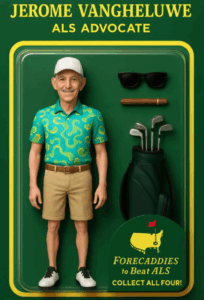
That’s why we named our foundation “Forecaddies to Beat ALS.” It’s a nod to how four ordinary kids, growing up together and sharing a love for golf, have stayed connected through this game. Even though my ALS has progressed, I’ve been lucky compared to many others. Most people don’t get a chance to try and help others and for this I am truly grateful. Our foundation has given me that opportunity through our annual golf event, where we raise money to fight this disease. I’m very proud of how much we’ve grown. In our first year, we donated $53,000 to help families affected by ALS. The next year, we raised $110,000, which we split between research and giving caregivers a break from the constant care their loved ones need. I’m grateful every day for the people in my life—especially my wife, kids, grandkids, and friends Dave, Kraig, and Paul—who are the heart of “Forecaddies to Beat ALS”.